Ongoing Projects
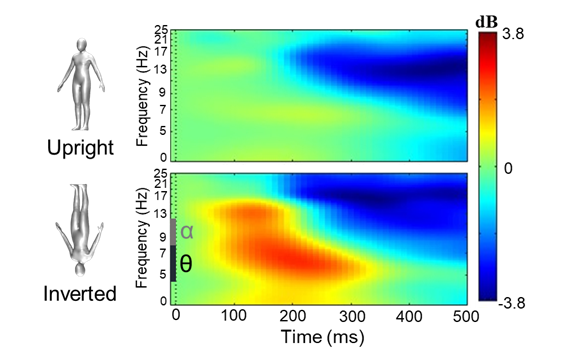
Time-frequency plots for a body inversion matching task in healthy controls (n=4). Averaged activity from right occipito-temporal electrodes (P8, PO8, TP8) shows that body inversion modulates early theta and alpha power.
Brain mechanisms of appearance misperception in body dysmorphic disorder
Investigating how bottom-up and top-down processing of bodies and faces contribute to misperceived body image. This work is supported by the 2025 International OCD Foundation Michael A. Jenike Young Investigator Award.
People with body dysmorphic disorder tend to over-attend to isolated features of their appearance at the expense of seeing the face or body as a whole. This study records EEG while participants complete face and body inversion matching tasks and a part-whole face matching task, paradigms that separate holistic from feature-based processing. Comparing adults with and without BDD, the goal is to identify where in the visual processing stream this imbalance emerges and whether it tracks symptom severity.
Mentor: Jamie D. Feusner, M.D.
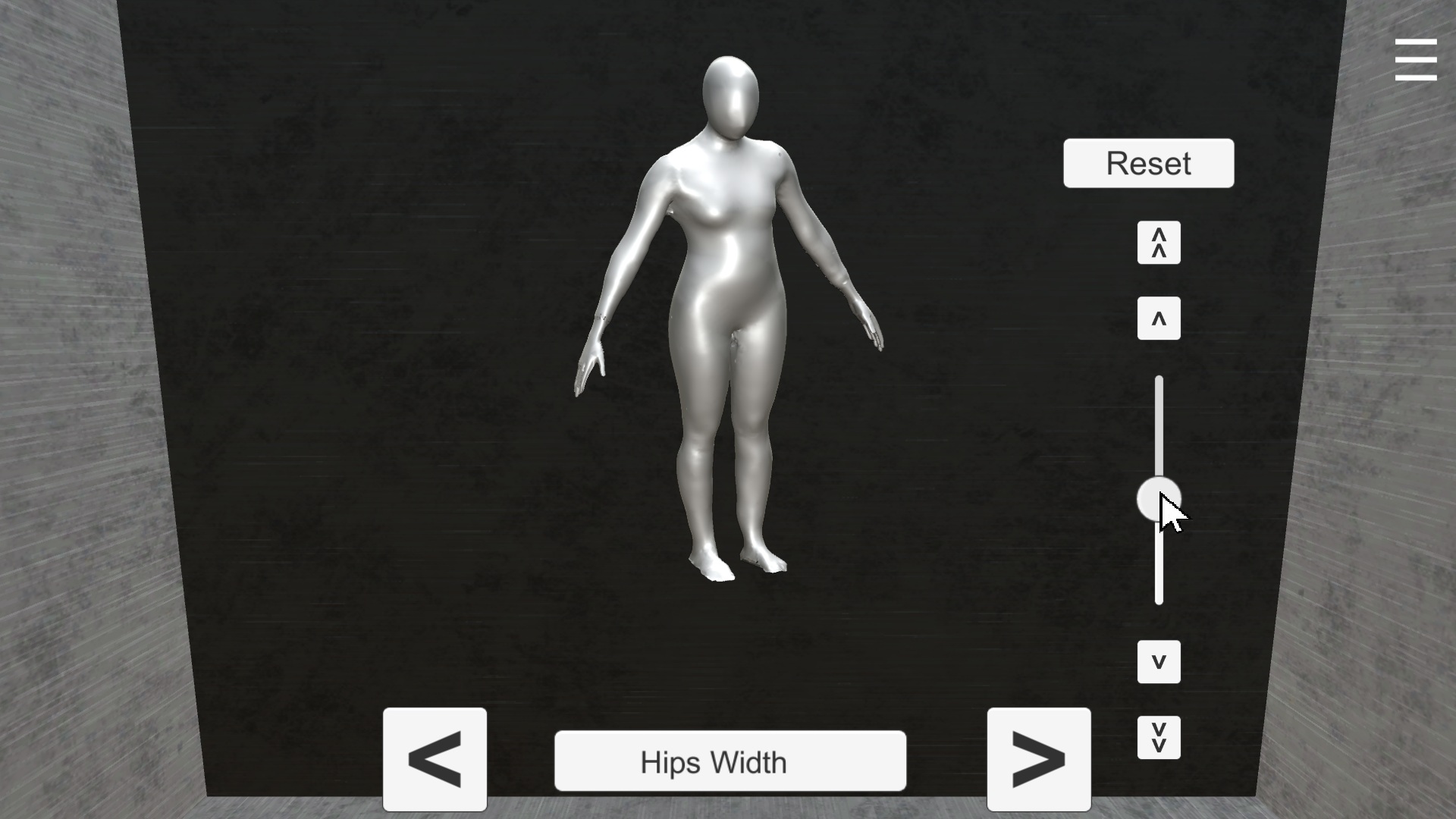
Somatomap 3D avatar tool used to assess body image perception. The app includes 26 selectable body parts, each adjustable in size and shape using a slider. The avatar can be rotated and viewed from all angles.
Characterizing body size misestimation using a 3D avatar
Investigating neural and behavioural mechanisms of body size misestimation in body image disturbance. This work is supported by NIMH research grant #3R01MH121520-04S1.
Body size misestimation is central to body image disturbance, but its neural basis is not well characterized. Using an fMRI-compatible version of Somatomap 3D, participants adjust the size and shape of 26 body parts on a rotatable avatar until it matches how they perceive their own body. In healthy adults the task engages the extrastriate and fusiform body areas, premotor cortex, and superior parietal lobule, with parietal activity tracking individual differences in estimation accuracy, making it a candidate substrate for altered body representation in eating disorders and BDD.
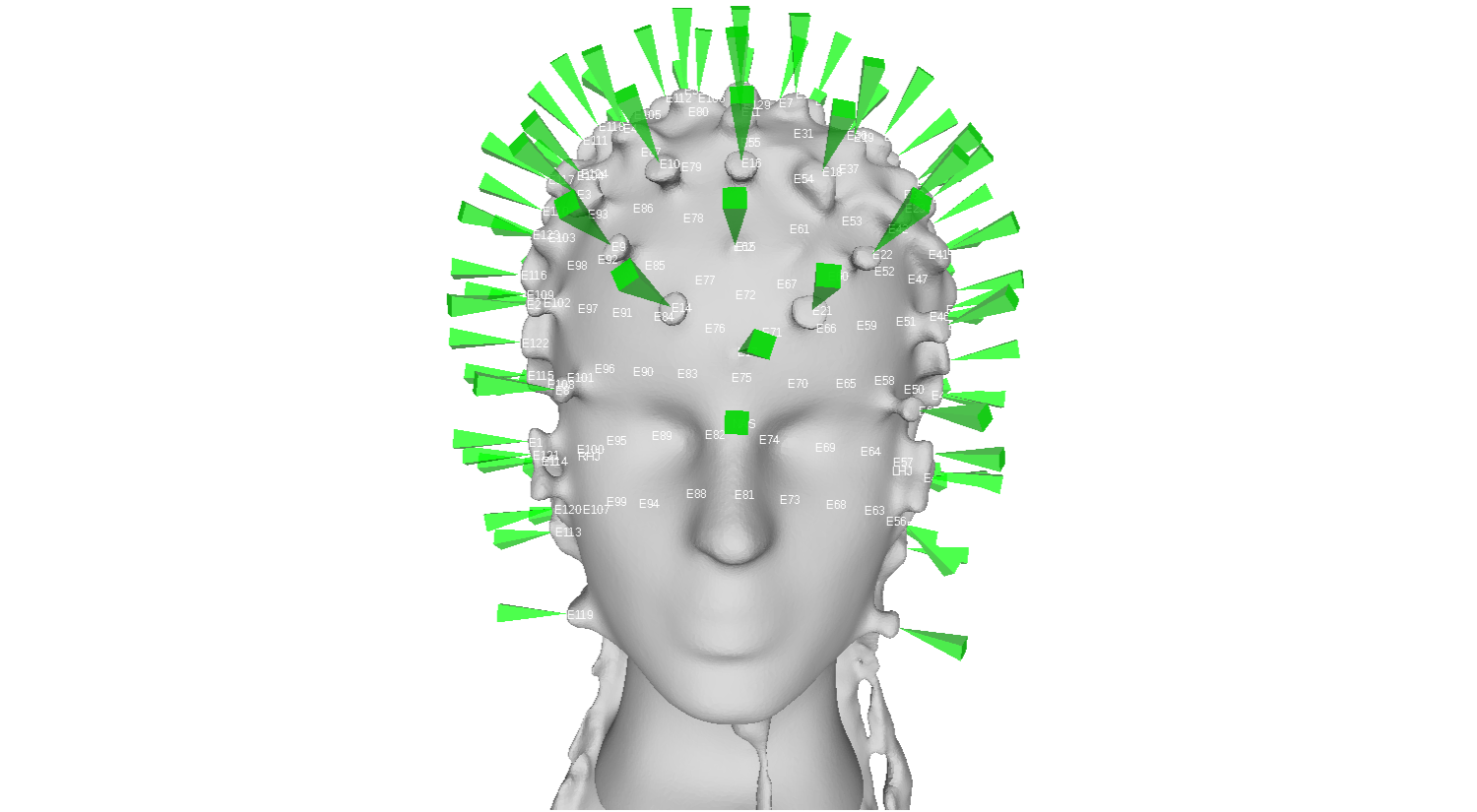
3D head model for EEG electrode localization created using a portable 3D scanner.
3D Head Models for EEG Spatial Localization
Developing protocols that leverage 3D head models to improve the accessibility of EEG electrode localization.
Knowing where each electrode sat on a participant's head is essential for source-level EEG analysis, but the dedicated digitizers that measure this are costly and slow. This project develops and validates lower-cost alternatives, including handheld 3D scanners and offline video-based photogrammetry that reconstructs a head model from ordinary video footage. Published protocols cover electrode localization in MeshLab and a photogrammetry workflow.
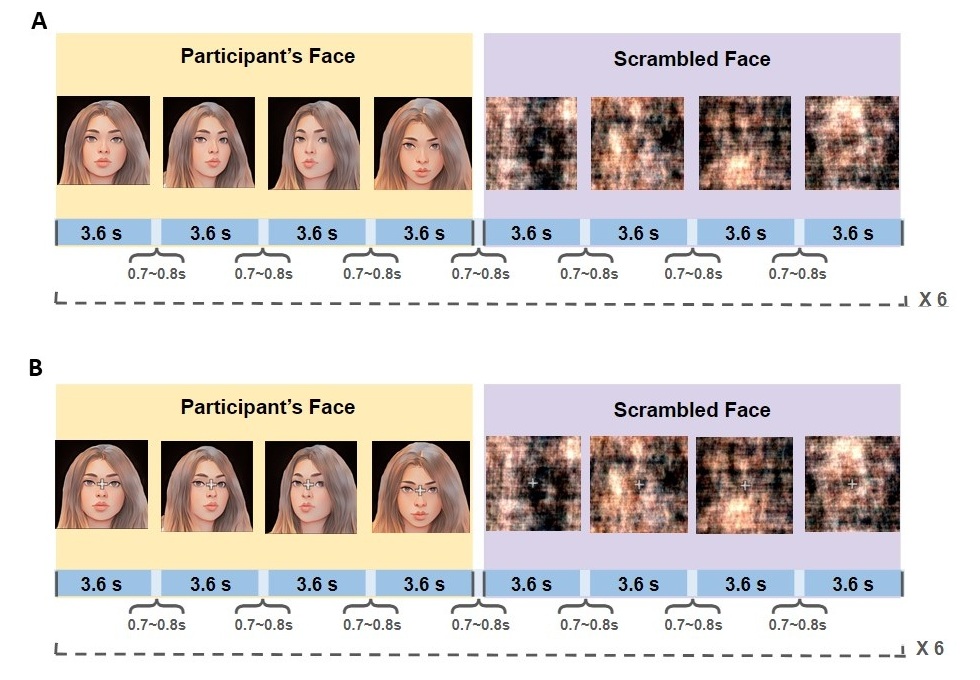
Visual Attention Modification fMRI Task Paradigm.
Visual attention modification in BDD
Neural mechanisms of perceptual abnormalities and their malleability in body dysmorphic disorder. This work is supported by NIMH research grant #R01MH121520.
The visual attention modification paradigm asks participants to hold their gaze on a crosshair centered on a photograph of their own face, discouraging the feature-by-feature scanning typical of BDD. Relative to natural viewing, this lengthened fixations and strengthened occipital-parietal connectivity within the dorsal visual stream, and the effect carried over into subsequent free viewing. Weaker dorsal stream connectivity during natural viewing was associated with more severe BDD symptoms.
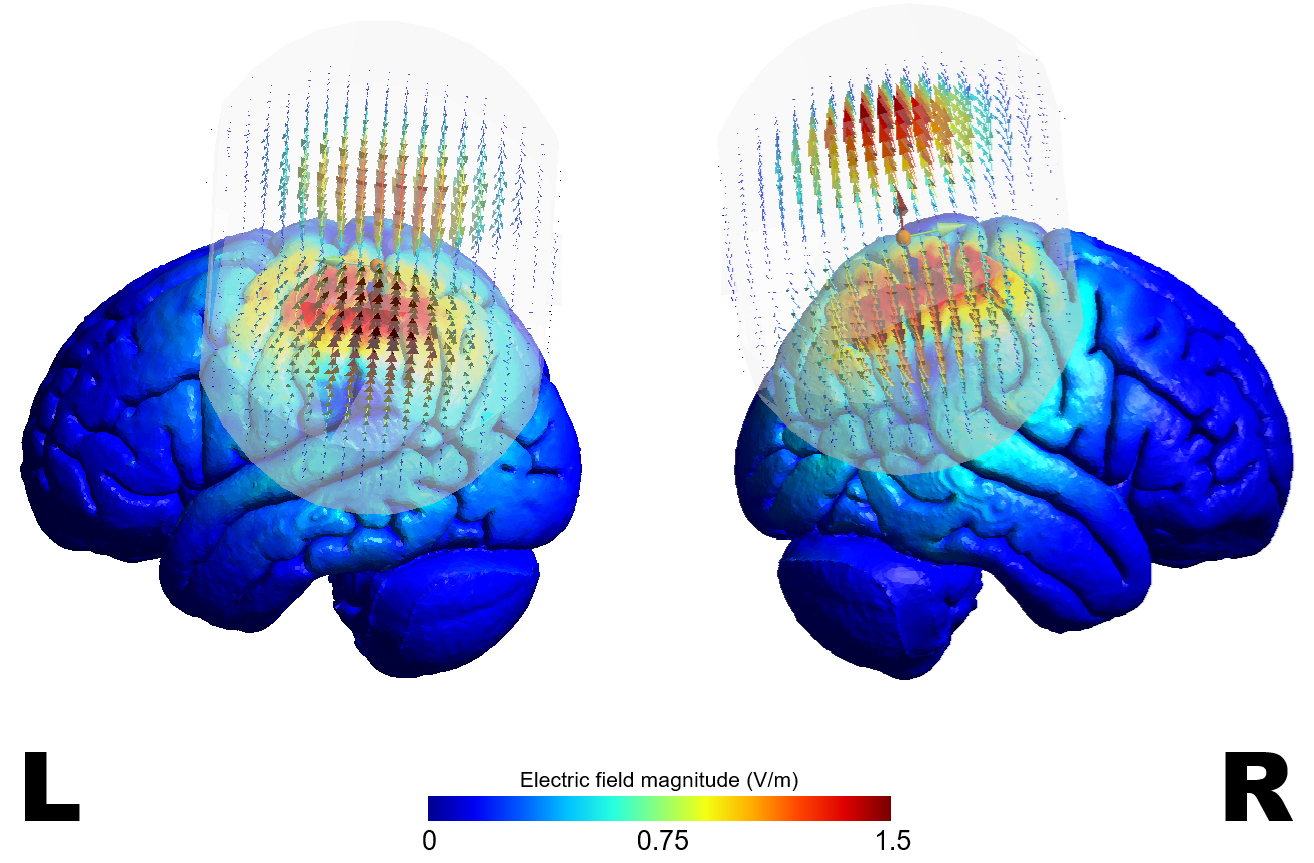
Simulation of theta-burst stimulation at the lateral parietal cortex target site.
EMPAC-BDD
Exogenous modulation of visual perception and connectivity in body dysmorphic disorder. This work is supported by NIMH research grant #R21MH128815.
This project asks whether non-invasive brain stimulation can shift the balance between detail-oriented and holistic visual processing in BDD. Participants received intermittent or continuous theta burst stimulation over lateral parietal cortex before viewing photographs of their own faces during fMRI, under both natural viewing and visual attention modification. The two protocols moved dorsal and ventral stream connectivity in opposite directions and altered the face inversion effect at different stimulus durations, suggesting that stimulation acts selectively on different levels of the visual hierarchy.
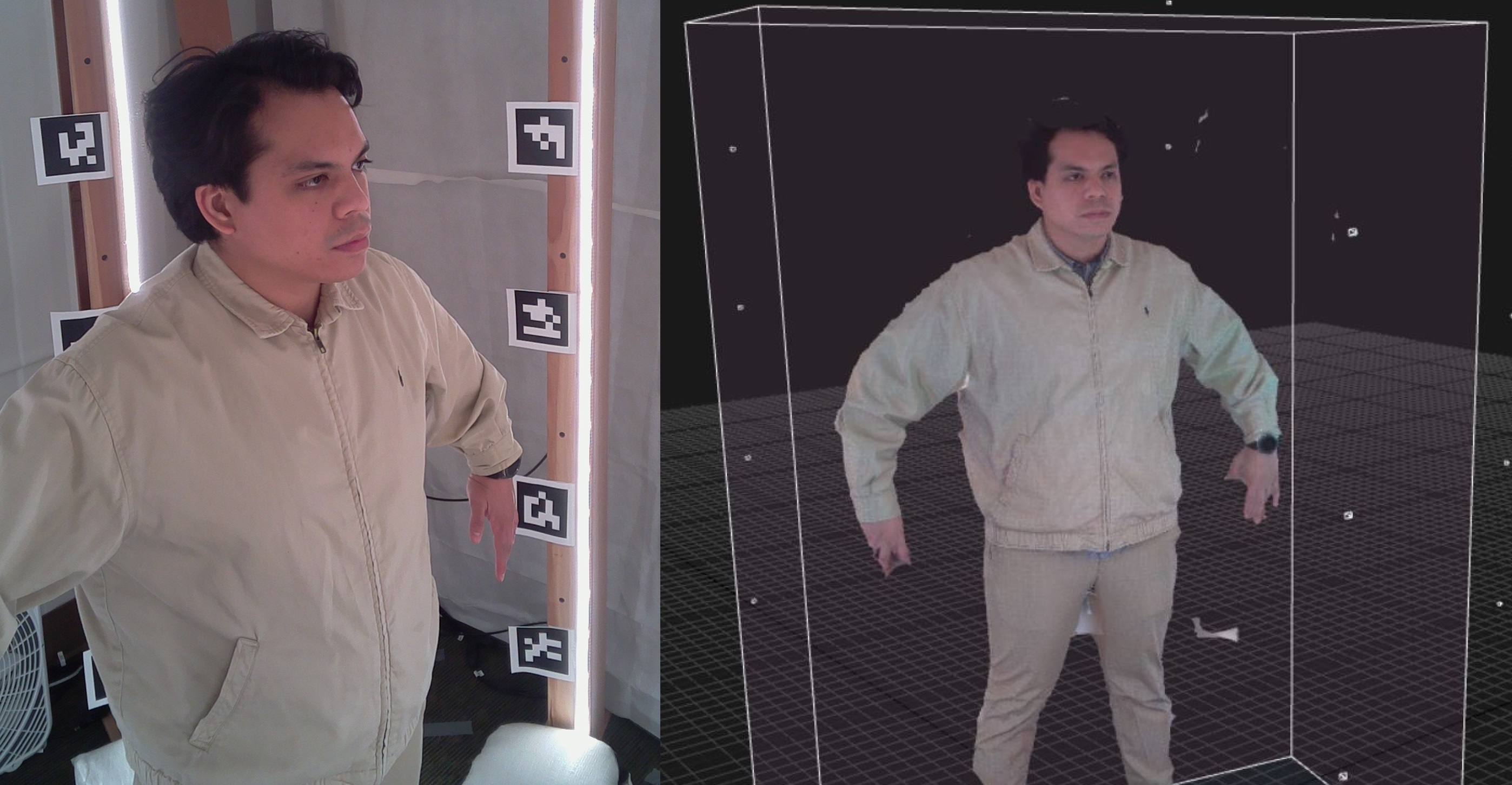
Photorealistic 3D model with full texture mapping, generated via photogrammetry using a Raspberry Pi-based camera system composed of 38 synchronized cameras.
Personalized 3D avatar tool for measurement of body perception
Development of a personalized 3D avatar system for measuring body size estimation and body perception.
Photorealistic avatars are generated from each participant’s own body using photogrammetry, captured with a custom Raspberry Pi-based system comprising 38 synchronized cameras. The resulting 3D model incorporates full texture mapping to preserve the participant’s individual body shape and appearance. Participants can then manipulate 26 individually selectable body regions on their personalized, rotatable avatar, allowing body size estimation errors to be quantified for specific body regions rather than as a single global measure.
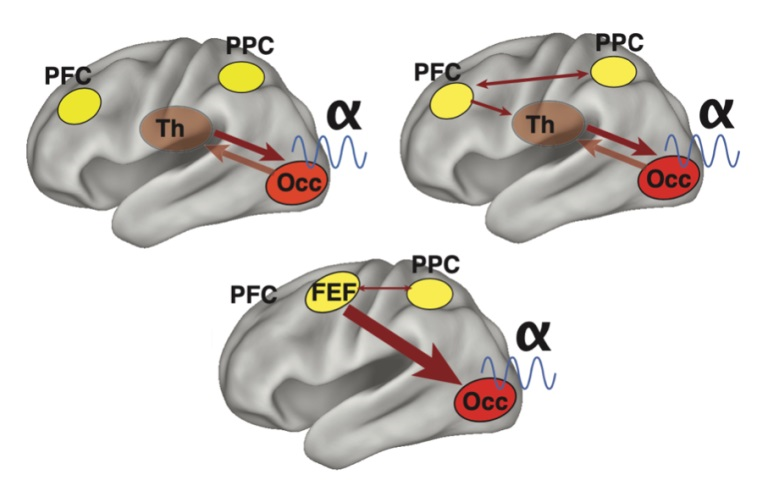
Modified from source: Lenartowicz et al., 2018.
Alpha oscillations and working memory deficits in ADHD
A multimodal imaging investigation of alpha oscillations and working memory deficits in ADHD. This work is supported by NIMH research grant #R01MH116268.
Posterior alpha oscillations gate which visual information reaches working memory, and this modulation is weaker in ADHD. Combining EEG and diffusion imaging in 115 children, this work found greater mean diffusivity in the anterior thalamic radiation in ADHD, and showed that the microstructure of that tract predicted alpha modulation during visual encoding, which in turn was associated with fewer inattentive symptoms. Ongoing analyses extend the design with functional connectivity to test the same pathway during task performance.